
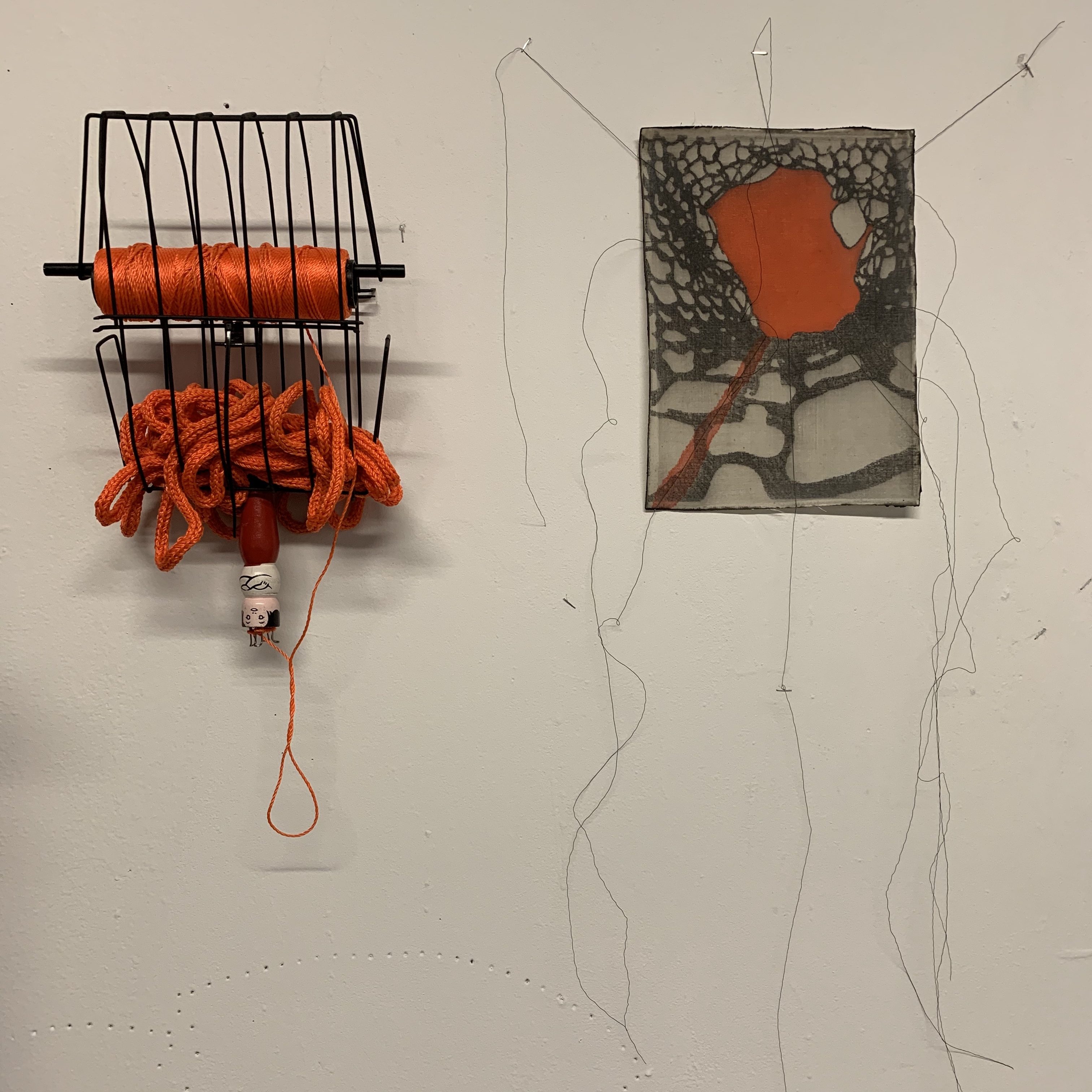
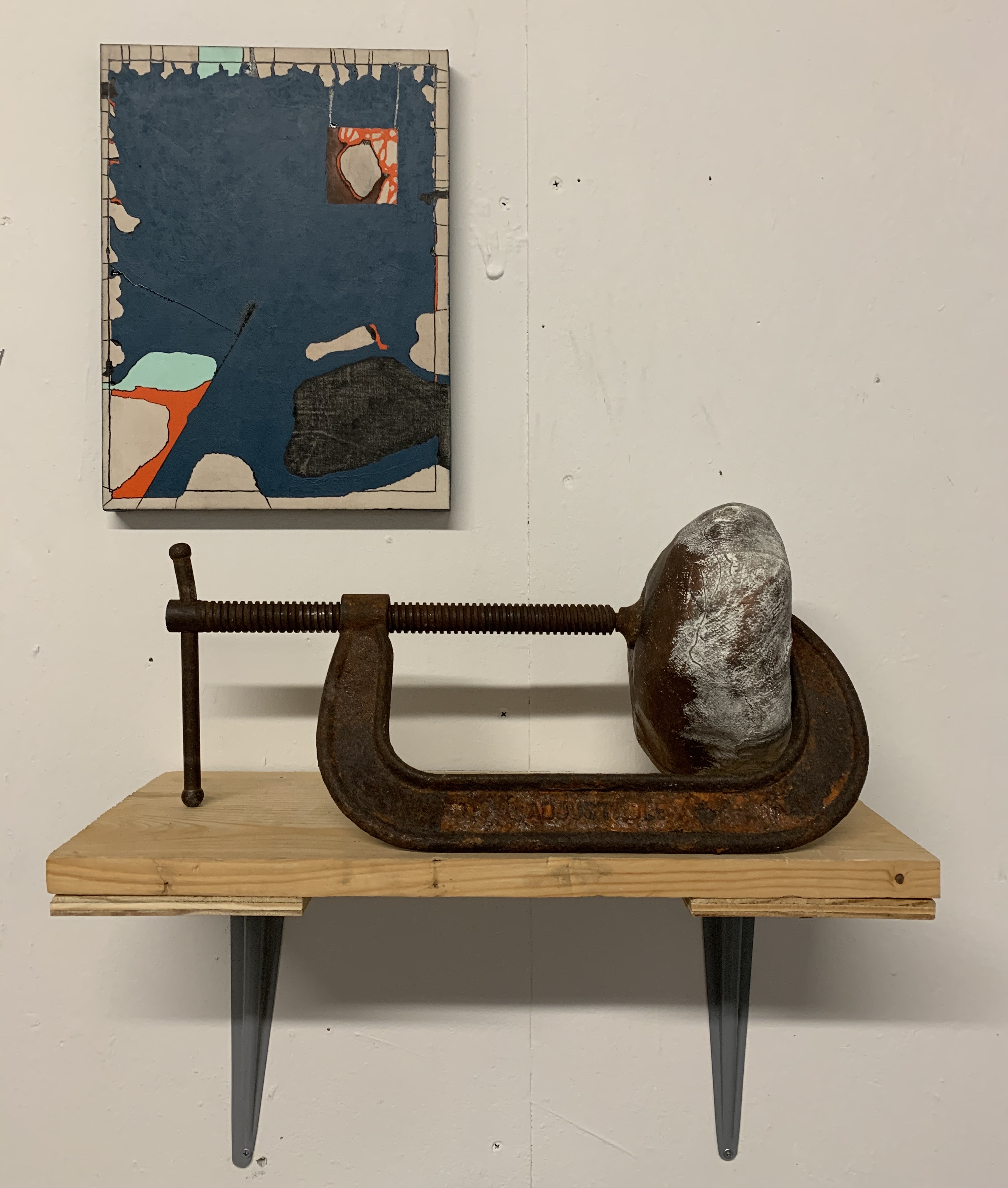


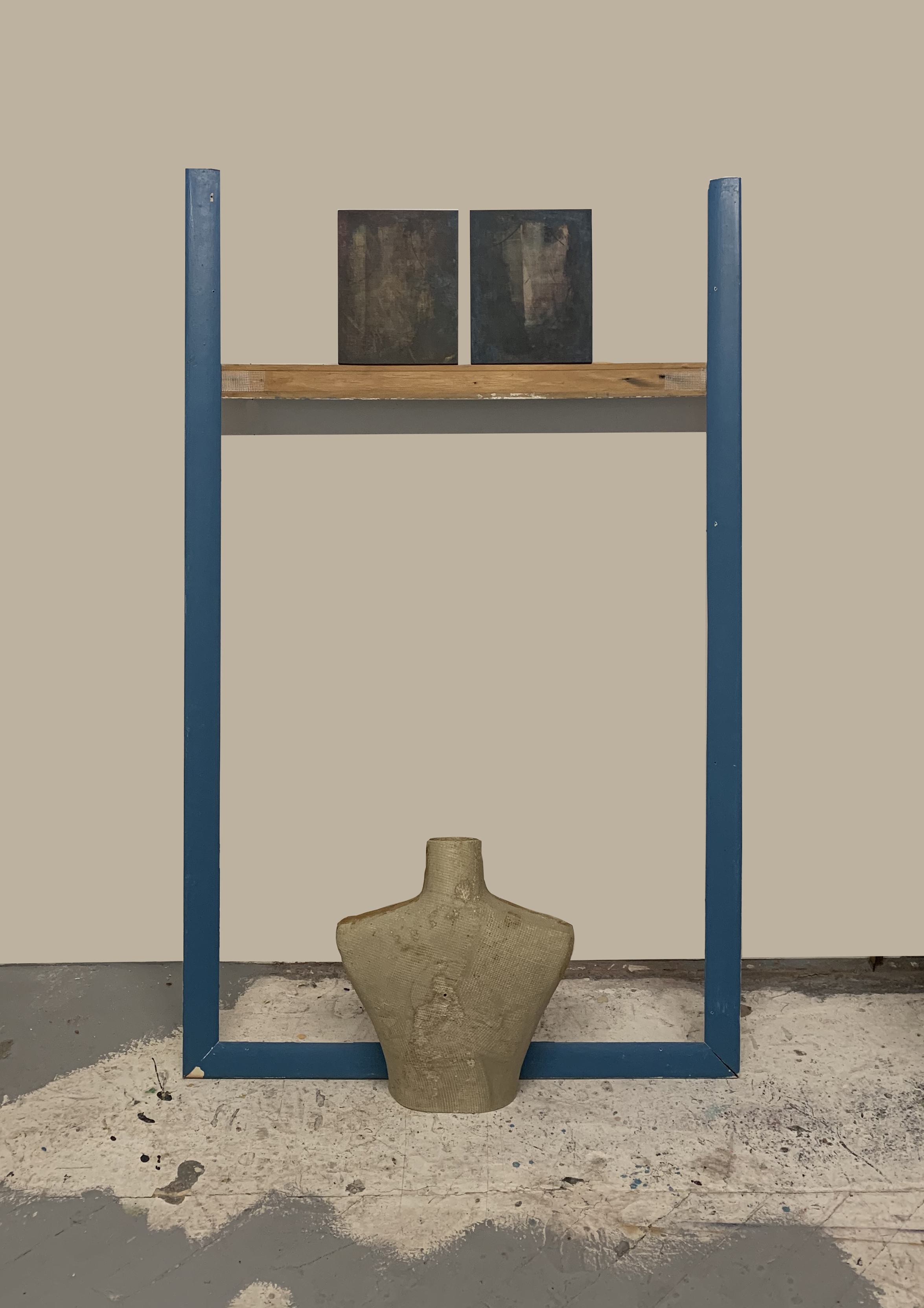
String loops around four anchor points set into the head of a wooden (knitting) doll. On each rotation a diamond shape is traced, gradually forming a rope into which it disappears, hidden inside. When more anchor points are added the diamond re-emerges as a new (knitting) head, a wooden surround for a much larger open rope, a net. Weighted and distorted by the diamond held within, numerous bodies emerge within the spaces of the net: an orange torso caught in a spiders web, an anchored vessel, a severed arm floating in the deep
three sub-texts / or ‘notes on the missing’
The diamond ‘in medias res’ (p3 The Odyssey Homer, translated by Emily Wilson)
Homer’s Odyssey is the story of a man whose grand adventure is simply to go back to his own home, where he tries to turn everything back to the way it was before he went away. But time has moved on and like the Odyssey this work begins in medias res (in the middle of things).
The ‘Ecstasy’ of little Olympus (p358 Ecstasy in The Nude: a study in ideal form by Kenneth Clark)
The phrase ‘little Olympus’ (coined by Walter Pater in his ‘Study of Dionysus’) serves as a reminder of the irrational in art-work and in the body, those elements of human nature, the remnants of animal impulse that the Olympian religion attempted to sublimate or subdue.
Athene’s nature and deeds’ (p 96 Greek Myths I by Robert Graves)
The titles used to identify the different bodies refer to various myths of Athene that sit outside Homer’s characterisation of the goddess as guardian and protector. Once the triple goddess, Athene was later reduced to a duality of ‘maiden’ and ‘crone’, her central ‘nymph’ aspect suppressed. An understanding of Athene that includes all her mythologies points towards a completeness that is able to accept many, often conflicting, narratives. As such Athene offers a mirror up to the necessary conflicts involved in our own odyssey, guiding our journey home to a reunion with the self.
bodies
Jealousy (Athene and Arachne)
Arachne , a princess of Lydian Colophon – famed for its purple dye – was so skilled in the art of weaving that Athene herself could not compare with her. Shown a cloth into which Arachne had woven illustrations of Olympian love affairs, the goddess searched closely to find fault but, unable to do so, tore it up in a cold, vengeful rage. When the terrified Arachne hanged herself from a rafter, Athene turned her into a spider – the insect she hates most – and the rope into a cobweb, up which Arachne climbed to safety
Shame (Minerva, Juno and Venus)
Athene invented the flute, the trumpet, the earthenware pot, the plough, the rake, the ox-yoke, the horse bridle, the chariot, and the ship (amongst many other things!). Minerva (the Roman Athene) once amused herself playing her favourite flute before Juno and Venus, but the goddesses ridiculed the distortion of her face in blowing the instrument. Minerva, convinced of the justness of their remarks by looking at herself in a fountain, threw away the musical instrument and denounced a melancholy death to him who found it.
The ships remain in harbor
without a tether, once they cross its bounds.
At the bays head there grows a long leafed olive, and near it is a beautiful dark cave,
a holy place of sea nymphs – Nereids.
Inside are bowls and amphorae of stone,
and buzzing bees bring honey. There are looms, also of stone, The Nymphs weave purple cloth, sea-purple – it is marvellous to see.
Water is always flowing through (Odyssey 13:100-109 )
Liberation (Athene, Nymph of the Sea)
The Nereid was invented to symbolise the liberated soul, a nymph of the sea floating into new life. With the power to ruffle or calm the waters Nereids were invoked by sailors. On the sea shore they sheltered in grottos and caves adorned with shells and shaded by vines
all armed and grown up
Athene is the goddess associated with technical and strategic skill, warfare, weaving, and other kinds of expertise. In Roman Mythology she is Minerva, who came all armed and grown up from her father’s brain. She generally appeared with a countenance full more of masculine firmness and composure than of softness and grace. In one hand she held a spear and in the other a shield. In most of her statues she is represented as sitting.
in memory of Pallas
The attribution of Pallas to the name of Athene remains unknown but there is a story that the name comes from a childhood friend she had, a nymph, who she accidentally killed when they were having a mock battle. Distraught, Athene carried her friend’s name with her forever more. The name, Pallas, means maiden and the Athenians made this maidenhood symbolic of the city’s invincibility. Pallas Athene had been the triple goddess – Maiden/Nymph/Crone – but when the central person, the goddess as nymph, was suppressed many of her myths were transferred to Aphrodite (and others). A maiden specialising in war and a crone inspiring oracles and presiding over all the arts are the dual aspects of Athene that remain.
 Elaine Fisher