across the divide

Elaine Fisher (de)posit(ory)(ion) (2016)

evidence for a returnable sum (across the melt water) arranged in reusable European-standard stacking containers:

400 x 300 x 74 mm wrapped pebbles
origin: Marloes cliffs, Pembrokeshire (photographic print on newspaper), East Quantoxhead beach, Somerset (pebbles)

400 x 300 x 175 mm photographic prints on newspaper
origin: Marloes cliffs, Pembrokeshire

300 x 200 x 118 mm bagged pebbles and photographic print on newspaper
origin: Marloes beach, Pembrokeshire (pebbles), Crooklets beach, Cornwall (photograph by Alex Pointer)

de- implying removal or reversal; deposit a returnable sum, lying in a displaced position; depository a store (of wisdom, knowledge); -ory denoting a place for a particular function; posit assume a fact, put in place or position; position the way in which a thing or its parts are placed or arranged

Divided by the melt water exhibition opens at UWTSD Swansea College of Art on 17 June

the supersensible world

thinking/making: catching thought in process

8 May 2016: The supersensible world

“It might only be through the engagement with the void of memorialisation that people are able to confront their consciousness of perception, because that is all there is.  What is not here is commemorated at the site of its disappearance…As a consequence, the most obvious way to set about this research is to detect signs of the missing objects’ effects.  This task is made possible by a complementary form.  In other words, the inverted supersensible world, is in itself signified by the existence of the actual world, just as quarried cavities are the inverse of monuments.  These antithetical objects are locked into a reciprocal bond, perpetually reflecting each other as necessary counterparts.”

Katrina Palmer End Matter (2015)

para(meter) test recording

testing recording devices in preparation for Weather Station (II)

“The human impulse – to separate and measure a constantly changing world – is critical to our present understanding of and reaction to climate change”

Measured and sampled by the Weather Station-come-trundle-wheel and the requirement to stop for ‘fresh air’, durational audio recordings will attempt to ‘hear’ the erosion in pebble size as I walk along Chesil Beach, using the sphere to separate pebble sounds from the predominant sound of the wind and crashing waves.  How will the recordings ‘hear’ the change in pebble size?  By their duration or differing content?  Or will my protective bubble completely deny what lies outside?

I will be finding out on Monday…..

Para(meter)
Weather Station (II)
Chesil Beach
Portland
Dorset
9 May 2016 (from 10am)

draw

thinking/making: catching thought in process

29 March 2016: Draw

Draw pull or cause to move towards or after one; pull a thing over, or across; attract – bring to oneself or to something; take in; take out – remove; obtain or take from a source; make one’s or its way – proceed; infer, deduce; make a demand on a person’s skill, memory, imagination; frame, compose; formulate or perceive; protract, stretch, elongate; approach its end; persuade to join – entice

(The Concise Oxford Dictionary p355)


Marloes Sands, Pembrokeshire 28/03/16


drawing

thinking/making: catching thought in process

29 March 2016: Drawing

drawing: a mechanism by which ‘things’ are held together, gathered

pebble (-) Anthropocene (concrete) pebble
(sliced) pebble with calcification
Anthropocene (brick) pebble

IMG_2990
(ENG)Land
(ENG)Lish
Lisp a speech defect; a rippling of waters
Lissom lithe, supple, agile
List a number of connected items to form a record or aid memory; a selvedge or edge of cloth usually of different material from the main body; lean over to one side
Listen to make an effort to hear something
Listening Post a point near enemy lines for detecting movements by sound; a place for the gathering of information from reports etc.

(The Concise Oxford Dictionary lingual-litany pp690-1)


(Nolton) Haven, Pembrokeshire 27/03/16


Para(meter)

ElaineFisher16

Weather Station II artists:
Laurie Lax  Laura Hopes  James Hankey  Nicola Kerslake Stair/Slide/Space  Phil Smith Jethro Brice  Simon Lee Dicker  Alexander Stevenson  Elaine Fisher

Weather Station is a project initiated by OSR Projects, a mobile pavilion for the collection of images, objects and ideas and an artist-led response to flooding and extreme weather, exploring the changing relationship we have with landscape and the natural world.  Regional partners  B-Side (Dorset), Backlane West (Cornwall), Exeter Phoenix (Devon), Hand in Glove (Bristol), Plymouth Art Centre (Devon), and Stair/Slide/Space (Hampshire) have selected artists to host the weather station and take part in a series of exhibitions and events.

Para(meter) has been commissioned in partnership with B-Side (Dorset) and will use the Weather Station to audio-record the phenomena of pebble sorting along Chesil Beach.  Measured and sampled by walking inside the Weather Station-come-trundle wheel and the requirement to stop for ‘fresh air’, durational audio recordings will attempt to ‘hear’ the erosion in pebble size, using the sphere’s micro-climate to separate pebble sounds from the predominant sound of the wind and crashing waves.

Refreshing an existing body of knowledge – LoopholeTide Table, Piddock Range and ness -ness nest nestle net  – (re)assembled through repeated walks along Chesil Beach, Para(meter) aims to highlight the human impulse to separate and measure a constantly changing world, critical to our understanding of and reaction to climate change.

Weather Station (Part I) brought together new and existing work by OSR Projects associates Jethro Brice and Simon Lee Dicker alongside work by Alexander Stevenson (selected by Hestercombe Gallery Curator Tim Martin) in an exhibition documenting its journey so far.

Weather Station (Part II) will take place throughout the South West between February and June 2016. Cumulative rather than collaborative, the structure passes from one artist to the next, gathering traces of its journey through the streets, fields and rivers of South West England and gathering on Portland for an exhibition at B-side Festival in September 2016.


Research-led?

thinking/making: catching thought in process

20 January 2016: Research-Led?

P1010499 (3) Lucy Gresley (2015)

Looking into artists to interview about their research I came across the term connected research.  This got me thinking about the term research-led used within our PREFAB-Lab project description and open call.  What does this actually mean?  To Lucy and I as practicing artists?  Is it the right term to encourage artists with a broad range of research methodologies to participate in our trial?  Who are we excluding?  Which artists might self-exclude because of the language we have used?

“My need to keep connecting, understanding and making meaning out of everyday encounters drives my artistic practice.  My artistic practice is therefore research-led, driven by its subject, the human drive or impulse to be in the world, to find out about the world in which we live.  Yet this research is non-specific.  There is no clear aim.  It is dependent upon an encounter to propel it forwards, towards a particular investigation, towards an understanding of something.  It is this act of going towards that I define as research, even if the destination is unclear.  Towards is the endless question to my endless quest.  What am I doing? Why am I doing THIS? What meaning can I ascribe to it? What is my research? How does it connect to what seems present in the world today? to what matters to other people? to what people are talking about?  I identify my research then through my practice.  It does not lead my practice.  In the same way I identify myself.  I think therefore I am.” 

We want to explore the differences between the terms connected research and research-led.  It seems that the idea of connectivity might serve both to free up the artistic impulse from preconceptions of what research might be and go some way to explaining the apparent ‘lack of fit’ between artistic research and art objects/installations we encounter at exhibitions – they may in fact be separate or separable things.  In which case why do we encounter one and not the other as an audience?  We want to open up a conversation that we can continue in the lab in May and June.  Whatever the terminology our questions are the same: What does artistic research look like?  How and where does it function?  What are the results?

Free submission, email PREFAB-LAB@fringeartsbath.co.uk deadline 14/03/16

an invitation to artists to participate in PREFAB-Lab (Practice, Research, Exhibition) an exploratory trial and interim analysis exhibition exploring artistic research through the lens of a scientific Research Lab  – what does artistic research look like? How and where does it function? What are the results?  http://www.fringeartsbath.co.uk/prefab-lab/

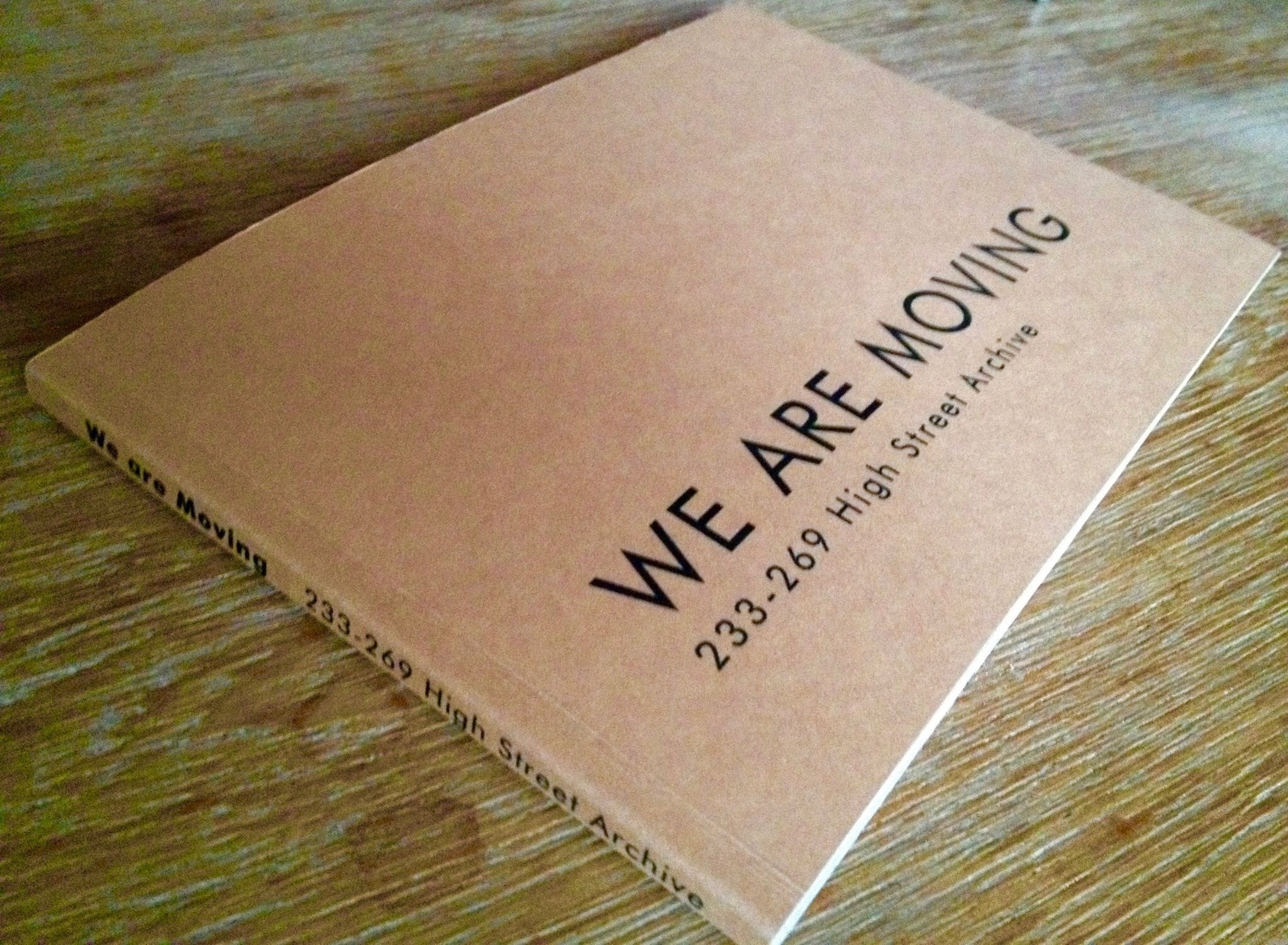
We are moving

John Andriessen / Sarah Bowden / Lauren Bridges / Tony Clancy / Elaine Fisher / Lucy Gresley / Vicky Hodgson / Ira Hoffecker / Will Lindley / Andrew Morrison / Mike Ward

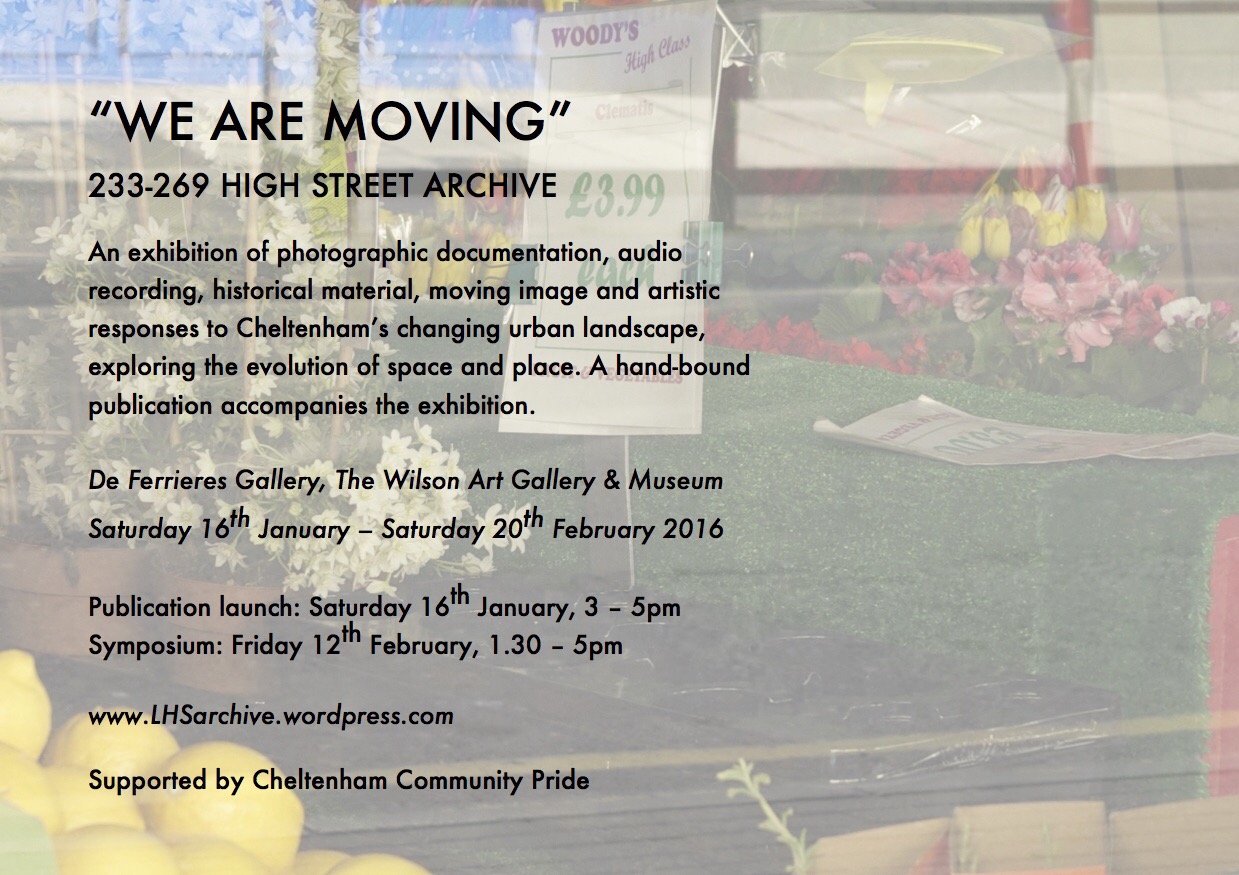
“We Are Moving” is an exhibition of photographs, recordings, archive material and artistic responses to changes taking place on Cheltenham’s Lower High Street as it undergoes redevelopment, an observation of the evolution of space and place. The exhibition will take place at The Wilson Art Gallery & Museum from 16th January to 20th February 2016.

The nation’s High Streets are increasingly contentious spaces where the cut and thrust of capital is enacted daily in mighty and mundane ways, so what and who is the 21st century High Street for? The symposium that accompanies the exhibition on 12th February will discuss the transformation of Cheltenham’s urban landscape in this context, exploring the idealism and imaginings of past times and seeking to envision future public and private environments, both for and not-for commerce.

Symposium attendees receive a free copy of the hand-bound publication that accompanies the exhibition. Entry £5.00 from

https://www.eventbrite.co.uk/e/we-are-moving-the-future-of-the-high-street-tickets-20136078553

The Lower High Street Archive Project was supported by Cheltenham Community Pride


Research Lab

IMG_0120Research Lab is a new collaboration between artists Elaine Fisher and Lucy Gresley which aims to playfully identify, share and celebrate research in contemporary visual arts practice.

We are curating an exhibition for Bath’s 2016 Fringe Arts Festival (FAB2016) to consider the potential ‘lack of fit’ between artistic research and its publication at exhibition. PREFAB-Lab (Practice, Research, Exhibition) is an exploratory trial and interim analysis exhibition exploring artistic research through the lens of a scientific Research Lab  – what does artistic research look like? How and where does it function? What are the results?

This is an open call for artists with research-led practices to continue their research in a critically engaged shared space that is on view to the general public.

To take part artists must demonstrate:

  • A willingness to ‘work’ in PREFAB-Lab between 11am and 6pm for up to 9 days between 28 May and 5 June (minimum requirement 3 days) starting on either 28 May or 1st June
  • A willingness to comply with Lab Rules – to wear protective clothing as provided and follow lab protocols
  • A willingness to undertake standard observations of research activities and comply with regular monitoring and recording procedures within the lab
  • A willingness to leave your ‘work’ (at whatever stage in its development) in situ for the duration of PREFAB-Lab (28 May – 12 June)
  • A willingness to remain or return to PREFAB-Lab for a minimum of 1 day after the trial to lead guided tours for the public and/or participate in a symposium

Application:

  1. up to one side A4 defining research in your own terms/your current research project, what work you intend to undertake at PREFAB-Lab and confirmation of your willingness to participate fully in the research trial including the dates/durations you are available to participate and your preferred intake date (28 May or 1st June)
  2. up to 10 images (OR up to 3 audio-visual works) that best illustrate      your research-led practice
  3. applications by email to PREFAB-LAB@fringeartsbath.co.uk     closing date 14 March 2016

Submission is free.  Selection will be based on achieving a broad spectrum of research concerns at different stages of the research process and a commitment to participate fully in PREFAB-Lab.  Research concerns need not be tied to the site of the Lab, however, participants must demonstrate that some Lab-work will be undertaken each day of their trial.

Key dates

14 March deadline for applications
7 April selected participants notified
27th May PREFAB-Lab Preview 6pm
28th May PREFAB-Lab Intake 1 11am
1 June PREFAB-Lab Intake 2 11am
28th May – 5 June PREFAB-Lab open 11am – 6pm daily.  Visitors observe current Lab-work and view data from previous days.  
6-12 June PREFAB-Lab closed.  Scheduled guided tours of Lab and symposium
12 June PREFAB-Lab dismantled 3pm.  Collection of work by 9pm.

The Curators

(Elaine Fisher) Elaine’s research revolves around the human project – the drive or impulse to be in the world. Through a practice of personal encounter and re-assemblage she investigates ways to de-stabilise the notion of the human project as the pursuit of knowledge and re-imagine what it means to be in an uncertain and forever changing world.

(Lucy Gresley) For Lucy, making art is a continuing cycle of
enquiry into what it means to exist and how people are connected to each other. Using vessels as metaphors for people and their emotions and referencing theories of psychological development and philosophy, she explores the borderlines and tensions between things – how drawings intersect physical space and the relationship between subject and object, representation and abstraction. www.lucygresley.com

more exhibition opportunities at FAB2016